The Three Priorities of a Leader

When exploring management strategies and tools, a common one you can expect to encounter is the Eisenhower Matrix, used by Dwight D. Eisenhower during his military career and presidency, and popularized by Stephen Covey, the author of The 7 Habits of Highly Effective People. The matrix is a deceptively simple tool that guides how we think about our tasks and time using a 2x2 grid to sort responsibilities by importance and urgency.
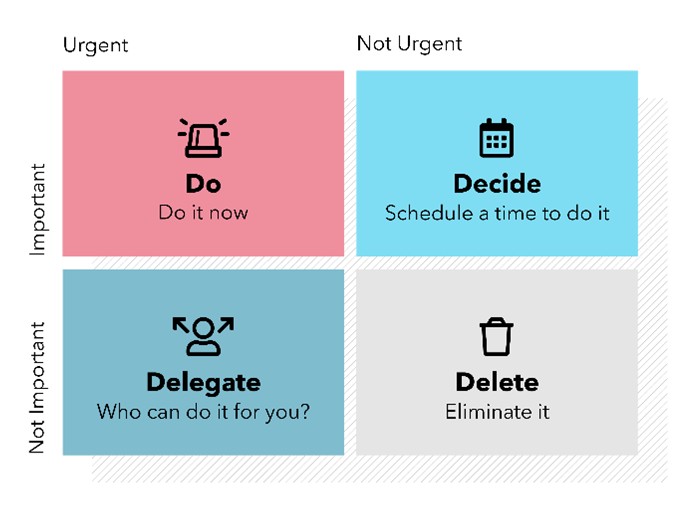
It’s a means to stop simply reacting to everything and to start acting with intention. Based on where a task or item falls within the quadrant can lead us to a particular set of actions.
- Is it important and urgent? Do it now; it’s a fire that genuinely matters.
- Not important but urgent? Delegate it. It may seem loud, requiring your attention, but it likely doesn’t require you.
- Not important and not urgent? Eliminate it. It’s draining energy without moving anything meaningful forward.
- Important and not urgent? Schedule these. This is where long-term growth, value, and development live.
This tool is valuable as it forces clarity of action, it breaks the cycle of our addiction to the urgency cycle (I’m important if I’m busy with the thing that has the most attention right now), and it protects the space where your best work and value happen.
But there is an underlying question to this matrix that needs attention and clarity―how do you determine what is actually important?
I have spent the better part of 15 years operating within and mentoring others to use a simple framework: the three enduring priorities of a leader. This framework applies to any role, level within an organization, and industry. I have used it as a staff member with zero direct reports and as a manager of a team of 150 people. This framework is what best helps me determine what is, in fact, important and what is urgent in order to apply Eisenhower’s matrix, ultimately giving me clarity on how to prioritize my tasks and my time.
Your Three Enduring Priorities
The three priorities are surprisingly simple. But simple does not mean easy. They are, in order:
- Do what is right.
- Do what your boss wants.
- Do what you want.
Let’s investigate each one.
First, do what’s right. Leadership starts with character. It is the first of three essential ingredients of trust: Character + Competence + Care = Trust. But, as Todd Henry explains in his book, Herding Tigers, you typically don’t lose trust in only one area. If you prove yourself to be untrustworthy in one situation, people tend to generalize that lack of trustworthiness to other areas as well. Jim Collins, author of Good to Great and Built to Last, asserts that there is no effectiveness without discipline, and there is no discipline without character. He claims that great leadership begins with character―that leadership is primarily a function of who you are, as it is the foundation for everything you do. How do you build leaders? You first build character.
Leaders’ first priority must be to do what is right―morally, within our societal and social norms, and in accordance with our organizational values. If our loyalty to our values conflicts with loyalty to anything else, say a peer’s or subordinate’s…or even a boss’s…actions, leaders make the “harder right” decision to hold people accountable to their “higher level loyalties.”
Leaders do what is right, first and foremost. We do the right thing, for the right reasons, and in the right way. We don’t tolerate deviations from what we expect and espouse. Nothing comes before this or is above this.
Second, do what your boss wants. This may sound quip, but this means prioritizing what your boss prioritizes. It can certainly be a hard idea to appreciate and accept. When I was at the start of my career, I struggled with this myself; I remember questioning why the organization would put me in charge of people if I couldn’t make every―or at least most of―the decisions myself and set the priorities for my team.
But we all have bosses. And our bosses have bosses. Each of these echelons has a broader understanding of the environment and requirements, and thus a clearer sense of what needs to be done. At our level, we may not see how our particular puzzle piece fits within the larger puzzle. Our boss does, though.
Regardless of how we feel about our boss and how they approach their job, we ought to recognize, understand, and support their priorities. It is a moral obligation, but it is also an organizational one. If we don’t align with and support our boss’s priorities, we create a chaotic and disorganized work environment instead of an effective and efficient one where everyone is committed to and acting within a set of commonly known priorities.
First, we do what is right. Then we commit time, effort, and resources to supporting our boss’s priorities.
Third, then you get to do what you want. It consumes time, attention, and capacity from leaders and the organization to attend to the first two priorities. But with what remains, leaders get to determine and act on their own priorities to continue to improve the team and achieve sustained, exceptional results at their level. This is where you do what you believe is important for your team. Leaders at every echelon have the responsibility to establish priorities for their team. But it is a matter of being opportunity-minded, not viewing yourself as a victim. We should aim to seek opportunities―and view them as such―when we get to action our own priorities. We are not victims of our circumstances, of our boss, or how little chance we perceive to have to act on our own priorities. We take advantage of the opportunities when conditions allow.
Set your priorities, find time and ways to action them, and do so with optimism and energy to continue to build your team because you get to.
Why These Priorities Matter
There are a few important reasons why we should feel compelled to lead according to these priorities. Through them we:
- Build a values-based organization. This approach focuses on building a values- and character-based culture where we champion our organizational, societal, and moral values. This creates a more ethical and more enjoyable place to work.
- Support an efficient, aligned organization. This framework encourages a nested approach to priorities so we don’t have different priorities at different levels that compete for attention and confuse our people. When aligned and clear, work becomes more efficient, then more effective, and eventually more enjoyable. People enjoy work when priorities and tasks are clear and coherent.
- Become actively engaged. We consistently scan our team and environment for opportunities to execute our third priority. We take the initiative, we are opportunity-minded, and we are not victims who don’t have the ability to do what we want. We may not get to do all the things we want according to our own priorities, but we can and must seize the opportunities to do what we can when we can.
An Interesting Added Benefit
I have practiced this approach in several different jobs with several different bosses. In each scenario, I’ve been surprised to find an unexpected but consistent benefit of living this out: I gained trust and more autonomy with my boss. With this trust and added space to work as I prefer, I poured even more time into my own priorities. Through disciplined adherence to these priorities, I actually gained more personal freedom of action.
When I consistently do what is right and achieve my boss’s priorities, I establish credibility. That credibility leads to trust and ultimately increased freedom in how I spend my time. My boss knows that I will get the results needed and do things to improve the organization when, where, and how I can. This grants me more time and space to act on my priorities as opportunity allows. He or she is not worried about how I spend my time, needing constant updates, or looking over my shoulder all the time. As a result, my people are better, the team is better, the organization at large is better, and my boss is able to spend their time on more important things as well. We have capitalized on afforded opportunities to do things like pour into leader development, team building efforts, ways to add new value to the team, and more.
Ideas for Implementation & Words of Caution
A few thoughts on implementation of the priorities and words of caution as you look to apply them.
- I’ve found the #1 reason many young leaders find themselves in hot water with their bosses or organizations is because they invert the list, or at least place priority #3 at the top. Although it’s often well intentioned with a leader taking initiative, it can come off as aloof or unsupportive of your boss’s priorities. Living out the priorities in order reflects well on you and your team from others outside and above your team.
- Use the priorities as a model to guide how you allocate your time and effort. When in doubt, default to tasks that fall higher on the priority list first.
- Also use this as a decision tool for when you experience “priority conflict.” When you feel like you are juggling too many priorities, pause, and categorize them by the list. This is a simple way to help turn subjective thoughts into more objective judgements. Then you can layer them onto the Eisenhower Matrix in order of the prioritized list. This way, the things that don’t make it onto the matrix or your calendar due to limited capacity, you know are lower priority matters.
- Priority #2 does not mean being a “yes man or woman.” Supporting your boss’s priorities does not mean blindly following your boss’s guidance. Nor is it about making you look good for personal benefit. It is about doing what is right for the organization. Leaders have an obligation to communicate context and perspective to their people on why they are doing things or why they are doing them a certain way. Submit to your boss’s priorities but also help your people see why. You can still act out priority #2 while managing up, seeking clarity on guidance, and offering feedback.
So, what is one thing you can do this week to act according to priority #1 and do what is right?
Take a few minutes to list out your boss’s current priorities (actually write them out if not already provided to you). If you feel like you are struggling to capture them, maybe you need to do some work to better understand them.
What is one thing you can do this week to take advantage of priority #3, even if it is just for a short 30- or even 15-minute window with your people?
When we lead with character, align with our boss, and then pursue our own priorities with intention, we create the conditions for trust, clarity, and meaningful impact. The Eisenhower Matrix becomes far more powerful when paired with this discipline. Lead in this order, and you’ll find that your time, your team, and your influence begin to work in your favor rather than against you.