What Happens When Leaders Ignore Management: Don’t Be Inspired but Ineffective

Have you thought about the difference between leadership and management? If so, have you decided that one has paramount importance over the other?
Well, if you have not, I will admit that I have thought a lot about this dichotomy.
Many of us may regard leadership as the highest expression of our professional identity. Management, on the other hand, tends to sit in the background—necessary, but uninspiring. I’ve spent a long time living inside that divide, and the more I’ve examined it, the more I’ve realized how much it shapes the way we think, act, and develop as leaders.
Sixteen years in the U.S. Army has made that tension impossible to ignore. We rarely use the word manager in roles or titles. People are the Army’s source of power, and leadership is the business of people—so leadership becomes the aspirational ideal. Management, by contrast, feels administrative, technical, even mundane. It’s not the thing people excitedly sign up to do.
Moreover, Army doctrine reflects that bias. In the Army’s 130-page foundational leadership manual, management appears only in passing—resource management as stewardship, personnel management as a system, training and risk management as broad categories. One short paragraph distinguishes leadership from management, but the overall message in the manual and how it is manifested in the Army’s culture is clear: leadership is the star of the show; management is a supporting character.
This is not a bash on the Army, of which I am a member, and I am not trying to say there is a problem. This is simply an observation of lived reality for me as well as likely many of you because our lived experiences reinforce the same story. No one rallies around the idea of being a great manager. Even in my own home, when I’m trying to coax toddlers toward first-time obedience at dinner or bath time, I instinctively ask, “Who wants to be the leader?” Leadership inspires and management doesn’t.
For years, I was fully on that leadership bandwagon. 3x5 Leadership is, in many ways, a reflection of that focus—purpose, direction, motivation, communication, connection, and alignment. I’ve written endlessly about leadership behaviors and have rarely given management more than a passing thought.
Then I stepped into the chief of staff role for a 150-person staff supporting a 4,000-person organization. Overnight, my world became management saturated. There were calendars, processes, systems, coordination, sequencing, resourcing, and [insert any other management buzzword you can think of]—my days were consumed by the mechanics that make organizations function day-to-day. And as I have since reflected on that experience, something became uncomfortably clear: even during the years when I preached leadership as the center of gravity, I was quietly relying on disciplined management practices to make my teams effective. I just didn’t name it.
That realization forced a shift. Leadership and management are distinct, yes, but they are also inseparable. And they are both important. Leaders who elevate one and ignore the other create avoidable friction, confusion, and drift. Leaders who understand both—and know when each is required—build teams that are not only inspired, but aligned, coordinated, and capable.
This exploration is about making that distinction useful. We’ll examine leadership and management as separate practices, organize them in a way that helps leaders develop both, explain why an integrative understanding matters for real-world performance, and finish with practical recommendations you can put into action now.
Understanding Leadership and Management
To integrate leadership and management well, we first need to define and clarify each practice.
Leadership is the practice of influencing people toward a shared purpose by shaping meaning, direction, and motivation. It is fundamentally relational and future-oriented. Leadership creates clarity, inspires commitment, and aligns human energy toward what matters most. Leadership practices include:
- Articulating purpose: why the work exists and why it matters
- Determining direction: defining the desired future and the path forward
- Motivating people: generating energy, ownership, and commitment
- Shaping culture: modeling values and reinforcing norms
- Building alignment: helping people see how their efforts fit together
Management is the practice of organizing work so that people, processes, and resources operate reliably and effectively. It is fundamentally structural and present-oriented. Management coordinates, sequences, and sustains the systems that make performance possible. Management practices include:
- Establishing processes: creating routines, workflows, and standards
- Coordinating execution: synchronizing tasks, timelines, and interdependencies
- Allocating resources: managing time, information, people, and materials
- Monitoring performance: tracking progress, identifying friction, adjusting plans
- Maintaining stability: ensuring predictability, consistency, and follow‑through
A few metaphors may help make this distinction stick:
- We lead people but manage things.
- Management climbs the ladder efficiently; leadership ensures the ladder is leaning against the right wall.
- Leadership focuses on the what and so what; management answers the now what.
The core argument is simple: leadership and management are distinct practices. Both, however, are important. Because of that, leaders need skillsets in both.
Organizing the Distinction (and the Integration)
Understanding the difference is necessary, but not sufficient. The real question is how we organize and apply these practices in real life.

I’ve long thought of leadership and management as two ends of a spectrum. Every role that is responsible for people and processes requires both, but in different proportions. Roles closer to the front line tend to emphasize management—that is overseeing daily execution—while senior roles emphasize leadership—more toward setting direction and shaping culture. Management never disappears, but leadership increasingly dominates attention at higher levels.
That spectrum still holds. But more recently, I’ve come to see leadership and management as distinct developmental assets, not just role-based behaviors.
When I ask myself what I actually need from leaders at any level, the answer consistently falls into three categories. I think of this as the Leadership Requirements Triangle. Each matters and each is distinct. Together, however, they form a complete leader. Let’s review the three levels within this model.
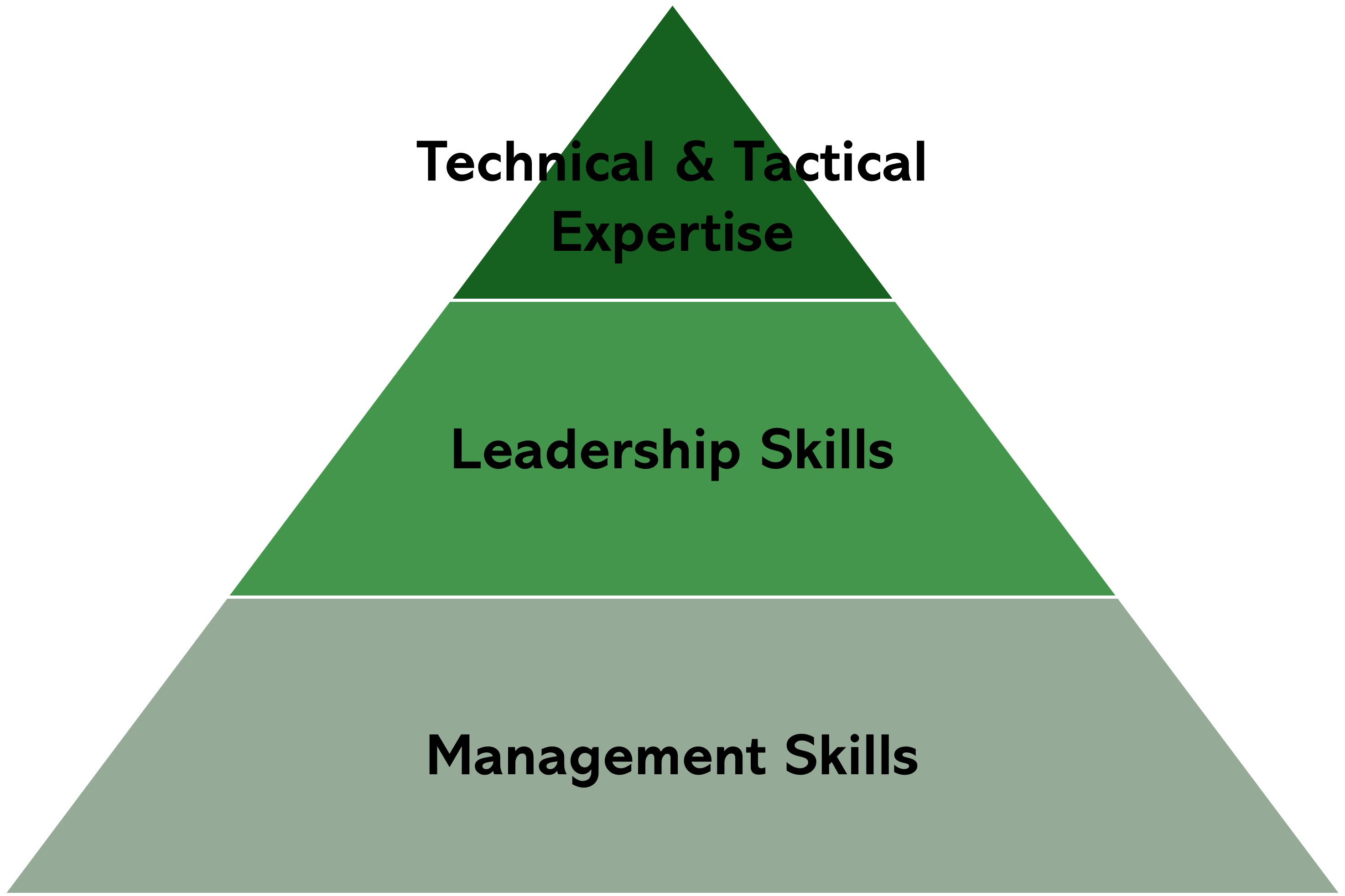
Management skills form the foundation. Leaders must manage critical resources—time, effort, tasks, information, communication, and attention. These skills create capacity, clarity, and momentum. Without them, everything else struggles. And while many leaders acknowledge the importance of management, few intentionally develop it in others. If we aren’t investing time and resources into building these skills, they aren’t a priority—they’re a hope.
Leadership skills provide meaningfulness and address the human dimension of work. Meaningful work is done for, with, and through people. People are not machines; we are messy, inefficient, and have complex mixtures and layers of identities that form a whole person. Leadership ultimately is a people business. So, leaders must cultivate equally important leadership skills like visioning, narrative-building, purpose-driven communication, connection, culture-shaping, and getting people to care. These are not innate traits; they are learned, practiced, and refined. Leadership is a skillset, not a personality type.
Technical and tactical expertise completes the picture. Leaders must understand the domain they operate within. Having exceptional management and leadership skills alone does not make someone best suited to become a CEO in a big tech company, a professional or college football coach, or a commander of an Army battalion. The required depth varies by field, but some level of expertise is always necessary. And like management and leadership, expertise must be intentionally developed—not assumed.
Together, these three layers produce leaders who can design systems, engage people, chart a path forward, and execute competently.
Yes, This Actually Matters
Why does all of this matter?
Management creates capacity. Without solid management, leadership collapses under the weight of chaos and urgency. Management frees time, energy, and attention so leaders and teams can focus on what truly matters. Disciplined management, though important, is not the end; it is a means for us to create the capacity necessary to achieve a value-based and sought-after end.
Leadership creates clarity and focus. Time and attention are finite. Leadership decides what matters, what doesn’t, and where effort should go. Without clarity, teams burn energy without making progress, or worse, making progress towards things that don’t ultimately matter.
Leadership creates belonging and care. When people feel seen, valued, and connected to a purpose, they care. When they care, they commit themselves. When they commit, performance follows.
Together, leadership and management enable impact. One without the other produces either inspired chaos or efficient emptiness. Real, meaningful impact requires both.
Now What: Practical Steps for Real-Life Application
Here’s how this becomes actionable. Let’s look at a few recommendations for real-life implementation of a holistic leadership-management approach that you can start now, both for yourself and your team.
1. Lead yourself first. Your personal management practices ripple and magnify outward. Manage your time, energy, and attention with discipline so your team can operate with clarity and confidence.
2. Develop yourself intentionally. No one is going to naturally do this for you; do not wait for some senior leader to come feed you development like you are a baby bird. Map your strengths and gaps across management, leadership, and expertise. Lean into what you do well. Then, deliberately develop your gaps and needs. Employ an integration of powerful developmental strategies like goal setting, mentoring and coaching relationships, and the ever-expanding world of knowledge (books, articles, podcasts, etc.) to do so. Start with one thing―a specific behavior, skill, or attitude. Learn, practice, seek feedback, and iterate. Then move on to the next one for stair-stepped improvement.
3. Surface the management gap. In leadership-heavy cultures, management skills are often subtly undervalued and thus underdeveloped. In turn, people are quietly forced to develop those important skills on their own, on the job, with little form or guidance. This creates a despairing deficit in management skills across the organization, where people quietly hide and “fake it” due to insufficient skills as they move up the organizational chain, resulting in overall organizational inefficiency. Use your voice to publicize the value of management skills and normalize learning them.
4. Balance development across all three domains. Assess your team’s current needs. Where are you overinvested in developmental focus? Where are the gaps? Adjust accordingly, either at your own level, or by finding an opportunity to fill the gap up the chain.
5. Use simple management tools consistently. Effective management often looks like a clear owner who runs a repeatable process through a visible platform. Start with the basics: a calendar, task system, and predictable rhythm.
Conclusion: Choose Integration Over Illusion
Leadership without management feels inspiring—but it doesn’t last. Management without leadership feels efficient—but it doesn’t matter.
The leaders who create real, sustained impact are those who don’t choose between the two. They integrate them. They develop them. And they model them for others.
So, here’s the call to action: Take an honest look at your own practice. Where are you over-relying on inspiration and underinvesting in structure? Where are you managing well but failing to lead with meaning? Pick one concrete change—one system to tighten, one leadership behavior to strengthen—and commit to it this week.
Don’t settle for being inspired but ineffective. Build the capacity to lead and manage well.